
Showing posts with label GHGs. Show all posts
Showing posts with label GHGs. Show all posts
Saturday, 28 January 2012

Sunday, 22 January 2012
POO POWER! Part 4: Pigs farting Power!
Even though assessment for this blog is over... I know I did this not for my environmental conscience, but because I was FORCED to... I feel the need to carry on posting because I love the many uses of poo...and here is another example of POO POWER!
So the video shows a great way to sustainably develop.... income from pig farming, waste management, and energy production on a decentralised scale... tick tick tick for the World Bank's Rural development initiatives!
This technology is being rolled out at a global level, it is happening in India and China where rural populations are increasing and require energy and income like anyone else.
More on this to come!! Hopefully! :D
Disclaimer.... I do not want any marks for these posts after the deadline of submission, I would just kind of like to carry on if possible??? Is that bad?
So the video shows a great way to sustainably develop.... income from pig farming, waste management, and energy production on a decentralised scale... tick tick tick for the World Bank's Rural development initiatives!
This technology is being rolled out at a global level, it is happening in India and China where rural populations are increasing and require energy and income like anyone else.
More on this to come!! Hopefully! :D
Disclaimer.... I do not want any marks for these posts after the deadline of submission, I would just kind of like to carry on if possible??? Is that bad?
Tuesday, 3 January 2012
Eutrophication... Meatrophication! A pun on so many levels!
Eutrophication; another problem (partly) caused by meat
consumption.


Now I said I wanted to look into pollution caused by
livestock farming in a bit more depth… so I am going out to the open ocean…lol
not a very good joke is it?
There is a lot of material on the topic of eutrophication
and I have already touched upon it before in some of my previous blogs and
referenced some really useful sources. Here are three more!
The World Resource Institute commissioned three reports on
eutrophication or as they call them ‘Policy Notes’:
- Eutrophication and Hypoxia in Coastal Areas: A globalAssessment of the State of Knowledge. (Selman et al. 2008)
- Eutrophication: Sources and Drivers of Nutrient Pollution.(Selman and Greenhalgh, 2009a)
- Eutrophication: Policies, Actions and Strategies to AddressNutrient Pollution. (Selman and Greenhalgh, 2009b)
The reports define eutrophication as ‘over enrichment of
water by nutrients such as nitrogen – and most topically for us – phosphorous’.
Selman et al. (2008) shows the extent of the problem. In the
United states and Europe’s Atlantic coastal waters, 78 and 65 % of the
respective areas were exhibiting some symptoms of eutrophication. In this case
symptoms of eutrophication include the most common hypoxia and algal blooms.
The severity of the problem is not widely known due to the
poor monitoring of global ocean water quality. Like with many research projects
funding is required; most countries especially those who face challenges of
greater importance (like epidemics/droughts/famines/natural disasters/wars)
simply cannot spread resources to measure a trivial data set when there are
more important things to hand.
However what is known is the responses of the ecosystem.
Initial growth of phytoplankton, micro-algae and macro-algae; these can cause:
- Reduction of light penetration into waters (planets below the surface of the water cannot photosynthesise as the light is being absorbed and blocked out the excessive algal growth).
- Benthic (bottom-dwelling) aquatic community species change, less biodiversity.
- Algae can outcompete coral larvae for nutrients, so there is reduced coral growth.
- A shift in the phytoplankton species composition, allowing toxic algal blooms to develop.
- Collapse of oxygen reserves in the water resulting in ‘dead-zones’.
These symptoms damage the ecosystem and more importantly
inhibit its economic potential, either directly through ecosystem servicing
(what you can ‘harvest’ from the ecosystem, i.e. fishing; biodiversity; carbon
sequestration) or indirectly through loss of income from reduced tourism;
reduced income from fishing; recreational facilities.
Hypoxic zones exist around the world. Some of the best
examples are the Gulf of Mexico (Mississippi outflow) and the Black Sea (Volga and
others outflow). Particularly in the case of the Black Sea, there is a strong
correlation between agricultural intensification in the 1980s and the size and
rate of the hypoxic zone formation. Since the collapse of the USSR, the Black
Sea has in part been in recovery.
Agriculture is not the only source of excess nutrients:
human and animal sewage (…yep POO and PEE!!!), urban runoff, industrial
effluent and fossil fuel combustion (not just more nutrients but more CO2
allows more photosynthesis/productivity as CO2 is generally seen as the
limiting factor in plant growth).
The relative importance of the sources of nutrients is
spatial. In Europe and USA, the biggest source is fertiliser application and runoff
into the sea via rivers; whereas in Africa, Latin America and Asia as
industrial regulations are laxer effluent is the largest contributor. Dry
nitrogen deposition (from volatilisation of fertilisers) adds to eutrophication;
Chesapeake Bay, in the US (as seen in an earlier post referencing Megan Smith’sblog) and the Baltic Sea in Northern Europe are good examples of this.
There is a necessity to collect information on nutrient
sources and their quantities and a time series of all factors involved; from
nutrient influx to chlorophyll, oxygen concentrations; quantifying the impacts
on income (cost of loss of fish production, etc.). Selman et al. (2008)
conclude with the importance of eutrophication to governments and the requirement
to never leave it unchecked.
Selman and Greenhalgh (2009a) goes on to further highlight
the significance of increased population (demographic pressures; 9.2 billion by
2050) coupled with greater demand for food and fertiliser to increase
production; intensification driven by changing dietary patterns, for instance
increased meant consumption up 54% from 2002 to 2030, during the same time
frame energy is expected to grow 50 %. Most of the growth will occur in the
developing world where there is greater vulnerability to resource pollution due
to lack of funds to cope with environmental degradation and the health
implications stemming from it (untreated water, spread of disease).
The tables from Selman and Greenhalgh (2009a) show nutrient
sources (table 1) and percent of treated sewage (table 2).


Focusing on agricultures role in eutrophication, fertiliser
leaching, runoff from agricultural fields, manure from concentrated livestock
operations and aquaculture are the largest sources. Focusing on manure (a
direct impact of more livestock) and fertiliser leaching and runoff
(proportional to livestock feed) the relationship between eutrophication and
these processes is strong. As shown from Cordell et al.’s (2009) paper with the
phosphorous source graph over time, inorganic P use has tripled since the onset
of the 1960s green revolution; eutrophication has also shot up. Nitrous oxides
(from farts!) also add to the N used by algae. An important note is they
mention that manure application to fields is timed not by necessity but by
storage; when too much is in stock, they ‘fertilise’ the land, this exacerbates
the run-off and leaching issue resulting in greater amounts of eutrophication.
Selman and Greenhalgh cite Ellis, 2007 and Mee 2006 as studies which show poor
pollution controls in China and also the production of an equivalent 5 million
inhabitant city quantity of excreta from a 1 million pig farming operation in
the Black Sea (respectively).
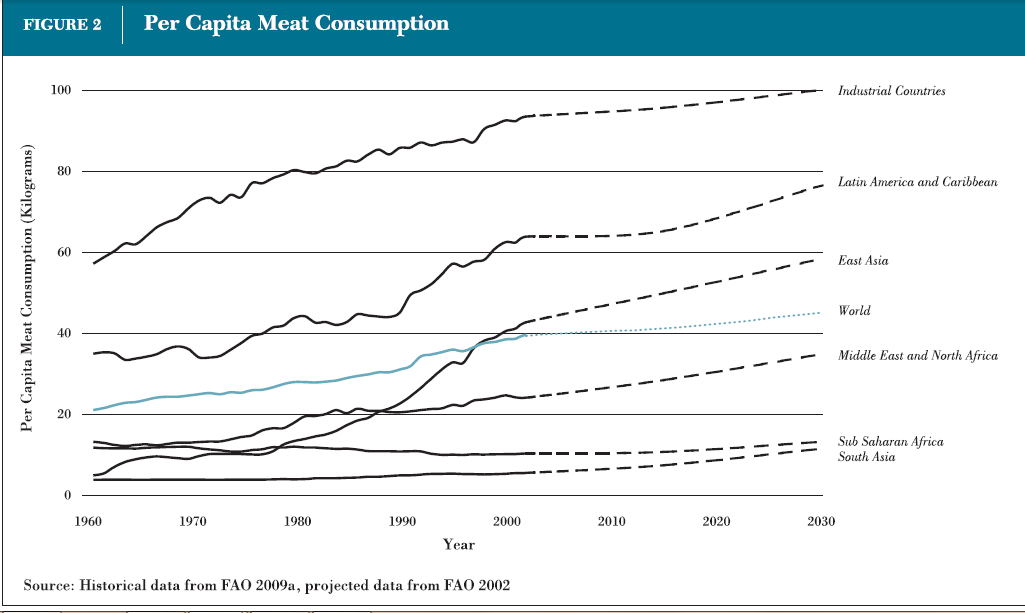
The Figures below show Meat consumption per capita against
time (figure 2) and projected fertiliser consumption (figure 3) (Selman and Greenhalgh, 2009a). The
link between meat consumption, fertiliser use, land use change, manure
production, population growth and eutrophication is clear; ‘a by-product of
unsustainable agricultural production and energy use’ (page 6).

The final report (Selman and Greenhalgh, 2009b) looks at the
potential to tackle this problem. Other than the issue of monitoring which has already been
looked at, they shed some light on other elements; increasing environmental awareness
and greater public knowledge of the problems faced due to our consumption
patterns.
Regulation and the imposing of standards in: environmental
quality; pollution (effluent/emissions) capping; technology (up-to-date and
efficient as well as sound).
Financial incentives like eco-taxes on environmentally
degrading products (like meat); subsidies like payment for ecosystem services
(PES) where a government subsidises farmers who employ an eco-friendly
agricultural practice at the expense of profit – that profit is then
compensated as the cost of the ecosystem service provided by the farmer (i.e.
less intensive use of fertilisers, ditch management, receive £50 a month rather
than production subsidies); eco-labelling and consumer awareness in the market
place (successful with free range).
Creation of protected areas via either nature preserves,
sites of scientific interest, national parks which all limit the types of
activity that can be performed in the area; land purchases and habitat
restoration and conservation (like in Chesapeake Bay).
The requirement for institutional support is emphasised as
well. Greater transparency, accountability and participation are all listed as
vital to the success of schemes from the outset, to implementation, to
completion. This is also the same set of criteria for what is referred to as ‘Good
Governance’ in development literature.
Summing up; it is integral to sustainability that
eutrophication is reversed. The issues around water quality are large. Where
agriculture and livestock come into it is simple, more meat requires more
fertiliser which produces more poo and other wastes! It is through the large
wastes in agriculture that we get side-shows of eutrophication which further
degrades our environment. What is needed as hinted to by the literature is a
holistic approach, a multi-disciplinary approach involving all parts of the
puzzle. There are successes highlighted in tables but that would be too much
copying and pasting!!!
Please feel free to read them, especially if interested on
the topic of eutrophication!
For an alternative summary please look at this site! It explains it in a much more eloquent way than I!
Save the water! Eat less meat! (I will try!!!) :D
Friday, 30 December 2011
Replying to a comment! Again!
This is another reply to another great comment posted on the 'Free the Turkeys! Put down that fork!!!' post made on Christmas Eve! Yulia K wrote:
"I agree, the last video you posted is very insightful, reminding us of the priorities. I like the idea of using pee for P and hope it materilizes, as this will provide us with a renewable source of P, alleviating one of the numerous global problems. However, your last three posts also made me realize something more gloomy, which is that in reality people choose to lead an unsustainable lifestyle, such as choosing to consume meat, and shift the blame for problems such as the global food shortages onto factors like biofuels, for example, which is what I am writing about in my blog.
It takes 3-4 times more P to support a meat-based diet and also more land to cultivate meat, as land is needed to produce cattle feed too. This means that meat production uses more natural resources, indirectly resulting in the food shortages. If we evaluated what our priorities are and all took responsibility for our own actions, would it not make more sense to lead a less meat-intensive diet, as this would free up the natural resources, such as land and P?
I find this issue very relevant to biofuels, as decreasing our meat consumption and food waste would likely result in less food shortages and free up more land for activities such as sustainable biofuel cultivation, which should result in GHG emissions savings and greater energy security. Would this not be more useful than leaving all as it is at present i.e. blaming so much on biofuels, for example, as the Gallagher Report (2008) seems to do, preventing the cultivation of biofuels, carrying on with our meat-intensive diet and high P consumption to then realize in the future that food shortages are still increasing as more and more people consume more, P and fossil fuels are running out and we are not prepared for that, and our GHG emissions have not decreased.
While I am also a hypocrite promoting a vegetarian diet here, my point is that I feel that too much emphasis is placed onto blaming industrial activities for the global problems and very little onto us, the consumers, which is not always useful. Therefore I very much agree with you that we should take greater action as citizens (I think this is what you were trying to say, if I understood correctly), even though technological fixes may help."
It takes 3-4 times more P to support a meat-based diet and also more land to cultivate meat, as land is needed to produce cattle feed too. This means that meat production uses more natural resources, indirectly resulting in the food shortages. If we evaluated what our priorities are and all took responsibility for our own actions, would it not make more sense to lead a less meat-intensive diet, as this would free up the natural resources, such as land and P?
I find this issue very relevant to biofuels, as decreasing our meat consumption and food waste would likely result in less food shortages and free up more land for activities such as sustainable biofuel cultivation, which should result in GHG emissions savings and greater energy security. Would this not be more useful than leaving all as it is at present i.e. blaming so much on biofuels, for example, as the Gallagher Report (2008) seems to do, preventing the cultivation of biofuels, carrying on with our meat-intensive diet and high P consumption to then realize in the future that food shortages are still increasing as more and more people consume more, P and fossil fuels are running out and we are not prepared for that, and our GHG emissions have not decreased.
While I am also a hypocrite promoting a vegetarian diet here, my point is that I feel that too much emphasis is placed onto blaming industrial activities for the global problems and very little onto us, the consumers, which is not always useful. Therefore I very much agree with you that we should take greater action as citizens (I think this is what you were trying to say, if I understood correctly), even though technological fixes may help."
My Reply:
Thanks for this EPIC post!
You are right; if we did eat less meat, then it would be
significantly justifiable to produce more biofuel. However like every other
resource or commodity it falls down to the distribution of the meat that is important. If the cost of meat actually took ecosystem service costs into
consideration as well as environmental valuations then the cost would increase
and there are potentially two outcomes: decrease in demand, reducing
consumption; increase in 'innovative' ways at maximising profits to reduce cost
production and increase consumption through economies of scale.
The first way would disproportionately affect those who have
the lowest incomes as cheap meat is sometime the only source of protein in a
diet as most substitutes cost a lot more. The second would lead to further
environmental and ecological degradation as intensive farming would become more
intensive at the cost of land quality, animal welfare and pollution.
The second point is relevant due to the EU 'wide' ban onBattery hen egg farming. A reported 80 million hens are being 'freed' (some are
going to be slaughtered) due to new legislation preventing the use of the
current intensive hen cages to produce eggs; a new 'enriched' cage (37% bigger)
has to be used.
This results in a just bigger than a sheet of A4 paper space
per chicken in a cage. Not that nice! (some info on ending factory farming here).
If we all became concerned consumers and thought about our
individual actions then we would achieve a lot more than holistic legislation
which is passing the buck of responsibility to people we pay and elect to act
for us. I agree with you. Consumption is the problem; and as consumers, we are
the ones who have to change OUR habits.
I hope this reply isn’t too bad! I like posting long posts
too! :D
Wednesday, 28 December 2011
Add a little P, get a load more Poo! Part 4: P reserves and losses!
Cordell et al. (2009)’s paper on the story of phosphorous is a MUST
READ!
It is packed full of information on the subject… but I will try my best
to extract the useful information. Being half Moroccan (half Italian), I can’t help but rub my
hands with glee… the largest stores of P are locating in the country
(regardless of what anyone says, Western Sahara does not exist in Morocco; we
call the southern provinces… moving swiftly on…!) as shown in the figure below from Elser and Bennet (2011).

This is however a big
problem in terms of global securities and power balances. With turmoil in north
Africa and the apparent ‘revolutions’ reaching their 1st birthday, it
is more important than ever that food and the fertiliser used, does not fall
into the same fate as it did 3-4 years back with the large prices rises in
grains (Elser and Bennet, 2011). 700% price rise in P coupled with the price
rise signalled a warning light to governments worldwide. However, as Cordell et
al. (2009) and Elser and Bennet (2011) note, the world still is not reacting to
this train wreck; they can’t even pull their act together on gas emissions and
the Kyoto agreement (COP Durban 2011 round of talks).
One thing is for sure is that if we use less, costs will go
down and we are less dependent on another out-sourced commodity that everyone needs.
If we all became vegetarian, then we would require significantly less P than a
meat based diet, and most of the crop can easily be returned to the soil as
residue, recycling most of the P used as a fertiliser. Even so; the largest
wastage of P originates in the poor application of fertilisers to soils (8
million tonnes, MT). Leeching of the synthetically produced nutrients results
in massive inefficiencies in P management; contaminating ground, surface and
coastal waters with high levels of nutrients had led to vast amounts of
eutrophication.
Eutrophication is when nutrients (either via leeching direct
from fertilisers or poor waste management) added to water bodies causes the
growth of organisms; algal blooms are a common example of added nutrients
altering the natural ecology of a body of water (lake, sea, estuary, etc.). (Smithand Schindler, 2009) The blooms photosynthesis at high rates, starving most
other organisms of oxygen (increased when the blooms die and decompose);
creating a hypoxic environment.
Please read more on eutrophication in these sites:
- http://rtseablog.blogspot.com/2011/03/eutrophication-mapping-first-steps-that.html
- http://feastingonnaturalresources.blogspot.com/ This blog, by Megan Smith is great! She also talks about agriculture and environmental issues surrounding the wider debate. I highly recommend her post on Coastal Eutrophication – The impact of Agriculture in Chesapeake Bay

Back to wastes of P and as the figure above (Cordell et al. 2009) suggests, 14/17.5 MT
of P go to agriculture; of that only 3 MT make it to our forks. 8 MT is wasted
through poor application, and of the 3 MT we consume as food, 1 MT is wasted as
spoiled food. By just eating within our means we save 1 MT. through better
fertiliser management techniques with save an extra 8 MT. It is easier said
than done, but through accurate monitoring of soil nutrient levels, we can guage
whether or not the land needs to be fertilised, saving energy, money and effort
as well as P. Using more natural fertiliser we can solve some of the problems,
by no means is sh… poo a panacea for eutrophication/power
insecurities/commodity prices/waste management/agricultural productivity and
the like, but it is a step in the right direction!
Reserves of P aren't well documented globally, in fact many researches, scientists, geologists and
mad hatters disagree as to how much P there is under ground. Cordell et al. (2009)
explores this using a number of different scenarios showing just how long it
would take, depending on how much P we need, to finally hit the last nail on
the head of the coffin that would be global inorganic P reserves.
Next part coming soon!
Wednesday, 2 November 2011
Contributions to global GHG emissions in a flow chart!
This flow diagram shows global GHG emissions from different sectors including agriculture; each sector is then divided up into end use/activity which produce GHGs, in this case 'livestock and manure' which is accountable for 5.1% of total GHG emissions directly (i.e farting); not including indirect forms of emissions from deforestation, feed or indeed energy used in their transportation (this is a separate flow).

From this image it is easy to see where the largest cuts in emissions could be from energy generation, especially when considering we have alternatives to conventional (but deadly) fossil fuel combustion.
The image is from: http://www.wri.org/chart/world-greenhouse-gas-emissions-2005.
Tuesday, 25 October 2011
So what is the problem with excessive farting (also burping, urinating and excreting)?
Why is it even an issue worth discussing in a blog dedicated to the world of excrement? Well the fundamental problem we face, not just as a species, but as inhabitants of earth, is climate change. We humans use the planet as our only home, kitchen, garden and toilet. Like any other confined space, when you begin to change the chemical make-up of the gas enclosed in that volume, you begin to change the overall physical, chemical and thermal properties of that gas. In the case of excrement, methane (CH4) and nitrous oxide (N2O) is produced through a variety of processes (as is carbon dioxide, CO2) which contribute to the greenhouse effect (Popp et al., 2010). Carbon dioxide is the most significant anthropogenic produced GHG due to the sheer quantity that is emitted into the atmosphere from human activities.
However, as I touched upon in the previous post, over 100 years, the same amounts CO2, CH4, and N2O have varying potencies due to their thermodynamic properties. This property is applied as a ration of heat trapped by one unit mass of the GHG compared to one unit mass of CO2; this is called the Global Warming Potential (GWP) (Pitesky et al., 2009). As it a ratio, CO2 has a GWP of 1; CH4 has a GWP of 23 (in the previous post I wrote that the potency of methane was 20 times that of carbon, it was wrong sorry!); N2O is 296 (FAO, 2006). From this data, it shows how important methane and nitrous oxide produced from livestock production, and in particular from poo, will be an increasing problem, not just as the total number of GHGs (CO2 and non-CO2) is set to increase from projected and modelled figures (Popp et al., 2010). In addition, with populations estimated to reach 9 billion by 2055 (World Bank, 2011) and increasing qualities of life reflecting greater demand for meat in the diet; livestock rearing is set to increase; that equates to a whole load of shhhhh… excrement.
The United Nations Food and Agriculture Organisation (FAO) commissioned a report on the impact livestock production has on the planet,Livestock’s long shadow (FAO, 2006). As a whole, livestock (either directly or indirectly) is responsible for 18% of total anthropogenic GHG emissions (FAO, 2006); those figures broken down into individual GHG include:
· Carbon dioxide (CO2) 9% of global anthropogenic emissions.
· Methane (CH4) 35 – 40% of global anthropogenic emissions.
· Nitrous oxide (N2O) 65% of global anthropogenic emissions.
· Ammonia (NH3) 64% of global anthropogenic emissions.
However, as I will investigate later on in the blog (or further towards the top of the blog), Excretion and everything does not just play an integral role to GHG emissions, it also plays a vital role in the nutrient cycle, particularly phosphorous and nitrogen. Phosphorous (P), as well as nitrogen (N) in the form of nitrates and other vital macronutrients like magnesium (Mg), potassium (K) and calcium (Ca) are required as well as a variety of other micro nutrients (Robinson, 2004). Phosphorous is often a limiting factor in plant production, due to its vital role as an ingredient in deoxyribonucleic acid (DNA) and ribonucleic acid (RNA), the building blocks of life; and in the Adenine triphosphate (ATP) which is the primary method of intracellular energy release and storage (Biology-Online, 2011), so we can all move, keep warm and most importantly… LIVE! Also, specifically to plants, P is necessary for healthy root growth, vital for the uptake of water and the other nutrients. The role fertiliser plays is significant, and indeed focusing on one of the nutrients, phosphorous, an increasingly important point has surfaced. Livestock (cows for example) need to eat; feed is created from plants; high amounts of land and biomass is required to produce vast amounts of feed; limited land resources dictates more intensive farming methods; greater dependence on higher yields; synthetic fertilisers created to provide the vital nutrients for plant growth; mining of phosphates from a finite source requires large amounts of energy whilst depleting the source.
As you can see, just from scratching the surface, cow (and other animals’) farts and poo pose a more serious problem than the humorous connotations applied to them suggest. Over the next few weeks and posts I hope to show you a greater insight in to the world of climate change, nutrients (re)cycling, pollution, eutrophication, renewable energy and many, many more uses, and subjects, which poo influences.
This blog may overlap with others, in fact it will. A post by fellow GEOG3057 blogger Emma (I hope she is Ok with me using her name), touches on the renewable potential of methane gas from… well cow farts. Another blog dedicated to the debate around biofuels can also shed light on the increasing diversification of energy sources, by another fellow GEOG3057 blogger Yulia. But those topics are for another time!
Next I hope to give you an insight into past methane releases and the relationships between the potent GHG and the atmosphere, looking at palaeo records of methane…essentially fossilised cow farts… Ok well some of the methane was produced by pre-modern time cows farting. Until then… watch those deadly emissions!
References:
Biology Online, 2011, ATP Definition. Available from: http://www.biology-online.org/dictionary/Atp. [Online] accessed 24/10/2011.
Pitesky, M. E., Stackhouse, K. R. and Mitloehner, F. M. 2009, Clearing the Air: Livestock’s contribution to climate change, Advances in Agronomy, 103, 1-40 pp.
Popp, A., Lotze-Campen, H., Bodirsky, B., 2010, Food consumption, diet shifts and associated non-CO2 greenhouse gases from agricultural production. Global Environmental Change, 20, 451-462 pp.
Robinson, G. 2004, Geographies of Agriculture: Globalisation, restructuring and sustainability. Harlow: Pearson Publications Limited.
If you find this sh.... stuff interesting then you might find these blogs interesting to!
Please check them out, as I try to myself!
Agriculture: Human Health and Earth Health: http://robs-agriculture.blogspot.com/
Biofuels: Way Ahead or Blind Alley: http://biofuels-wayaheadorblindalley.blogspot.com/
Fixing Climate Change: http://fixingclimatechange.blogspot.com/
Subscribe to:
Posts (Atom)