Showing posts with label chickens. Show all posts

Wednesday, 4 January 2012

How do you solve a problem like Maria eating meat? Alternatives!

VS


The end is nigh!

Well I am not talking about 21st of December... regardless of what those great survivors the Mayans thought (even if THE Britney Spears 'sings' a song about it) the world won't end; but one absolute certainty is that the cows will come home to fart....

The end of my blogging days may be over... screams of please no I hear?!? (or are they all 'Thank God!')... nevertheless I will try and look at the alternatives to a life in an atmosphere of animal farts.

From what the much of the literature points to as the driver in increased livestock production, demand seems to generate the largest fundamental factor in the quantity of emissions. So, to reduce emissions and other detrimental effects of livestock farming we have to reduce demand and consumption.

This is not easy... I personally do not want to stop eating meat altogether, although, after watching the documentary Mat the Truth, I was seriously contemplating going cold turkey... on turkey...

Proteins are vital to human health and life. So if we don't eat meat, what would we eat instead?

A commonly given example is fish. Fish is often seen as a better food stuff than meat, but fishing has caused a substantial amount of environmental damages as well as the state of fish stocks world wide ebbing closer and closer to depletion. The UN FAO World Fisheries and Aquaculture report (2010) states that 32% of stocks are over exploited/depleted or recovering; 53% are fully exploited and 15% are moderately exploited. Shifting more than a billion people in the developed world onto an already stressed resource will cause its collapse. Greater consumption of smaller fish which is environmentally sustainable and healthier for you is one option. If this resource is ever going to support an increasing number of people then sustainability is required, please read Worm et al. (2009) for an in depth insight into the potential approaches to take, most could be applied to other environmental problems; a multidisciplinary approach.

Corn, Soy and Grains are the food stuffs we generally feed to livestock. They are also very much fit for human consumption; but we tend to feed more of it to the meat we eat then personally consume ourselves. I personally don't eat corn... I know shoot me... but as you will find out in a later post (ooh foreshadowing I know right?!) I have taken certain steps in the right direction already!

This list doesn't look too impressive... but one factor easily neglected is simply reducing the amount of meat we eat. Meatless Fridays, or what Roman Catholics call Fridays... notable celebrities do it, Paul McCartney, Leona Lewis, they are talented because they eat a lot less meat... in fact none! OK... there is no link between talent and meat consumption. 

Reducing meat consumption has many benefits. You are healthier, richer (from not buying any meat, doesn't work if your meat originates in a five finger discount manner), aiding the environment in becoming less polluted and less full of cow farts. Also you can waste all those calories on chocolate, more room for nutella! OK I am not advising you to go on to an all nutella diet as fun as it would be, full of chocolaty goodness..... OMG it has been so long since I have had nutella I would kill love to have some right now..... *drools* mmmmmmm. Nutella pizza - nutella instead of tomato sauce and kinder in place of cheese. HEAVEN... like this, but rather than the nuts (which are a great source of proteins and energy!!!) add bananas... *collapses*.


10 minutes later....*wakes up*

Back to the point!

My New Years resolution is to eat less meat... so far I think I have eaten a little meat every day FAIL, but it hasn't been one whole week yet!

So I'll let you ponder about other foods you can stuff yourself with... but remember put down the fork, don't eat too much beef chicken or pork!

Friday, 30 December 2011

Replying to a comment! Again!

This is another reply to another great comment posted on the 'Free the Turkeys! Put down that fork!!!' post made on Christmas Eve! Yulia K wrote:

"I agree, the last video you posted is very insightful, reminding us of the priorities. I like the idea of using pee for P and hope it materilizes, as this will provide us with a renewable source of P, alleviating one of the numerous global problems. However, your last three posts also made me realize something more gloomy, which is that in reality people choose to lead an unsustainable lifestyle, such as choosing to consume meat, and shift the blame for problems such as the global food shortages onto factors like biofuels, for example, which is what I am writing about in my blog. 

It takes 3-4 times more P to support a meat-based diet and also more land to cultivate meat, as land is needed to produce cattle feed too. This means that meat production uses more natural resources, indirectly resulting in the food shortages. If we evaluated what our priorities are and all took responsibility for our own actions, would it not make more sense to lead a less meat-intensive diet, as this would free up the natural resources, such as land and P? 

I find this issue very relevant to biofuels, as decreasing our meat consumption and food waste would likely result in less food shortages and free up more land for activities such as sustainable biofuel cultivation, which should result in GHG emissions savings and greater energy security. Would this not be more useful than leaving all as it is at present i.e. blaming so much on biofuels, for example, as the Gallagher Report (2008) seems to do, preventing the cultivation of biofuels, carrying on with our meat-intensive diet and high P consumption to then realize in the future that food shortages are still increasing as more and more people consume more, P and fossil fuels are running out and we are not prepared for that, and our GHG emissions have not decreased.

While I am also a hypocrite promoting a vegetarian diet here, my point is that I feel that too much emphasis is placed onto blaming industrial activities for the global problems and very little onto us, the consumers, which is not always useful. Therefore I very much agree with you that we should take greater action as citizens (I think this is what you were trying to say, if I understood correctly), even though technological fixes may help."

My Reply:

Thanks for this EPIC post!

You are right; if we did eat less meat, then it would be significantly justifiable to produce more biofuel. However like every other resource or commodity it falls down to the distribution of the meat that is important. If the cost of meat actually took ecosystem service costs into consideration as well as environmental valuations then the cost would increase and there are potentially two outcomes: decrease in demand, reducing consumption; increase in 'innovative' ways at maximising profits to reduce cost production and increase consumption through economies of scale.

The first way would disproportionately affect those who have the lowest incomes as cheap meat is sometime the only source of protein in a diet as most substitutes cost a lot more. The second would lead to further environmental and ecological degradation as intensive farming would become more intensive at the cost of land quality, animal welfare and pollution.

The second point is relevant due to the EU 'wide' ban onBattery hen egg farming. A reported 80 million hens are being 'freed' (some are going to be slaughtered) due to new legislation preventing the use of the current intensive hen cages to produce eggs; a new 'enriched' cage (37% bigger) has to be used.

This results in a just bigger than a sheet of A4 paper space per chicken in a cage. Not that nice! (some info on ending factory farming here).

If we all became concerned consumers and thought about our individual actions then we would achieve a lot more than holistic legislation which is passing the buck of responsibility to people we pay and elect to act for us. I agree with you. Consumption is the problem; and as consumers, we are the ones who have to change OUR habits.

I hope this reply isn’t too bad! I like posting long posts too! :D

Saturday, 24 December 2011

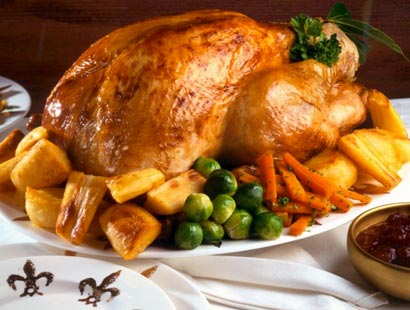
Free the Turkeys! Put down that fork!!!


Less than 1 hour to go, I fear that there is not enough time… the turkeys/chicken/pigs/sprouts are already dead and in your fridge…MURDERERS! (lol jk!)

So… whilst you tuck in to your no doubt incredible spread for Christmas dinner/lunch (or even breakfast-weirdoes!) and maybe saying grace, spare a thought about the meat you’ll be eating - not about the most probably sad lives they had running, well squeezed walking, cooped up in a large industrial scale production house – but the emissions they produced and the smell *coughs*.

I could give you a lecture on ethics of meat production but that would be so hypocritical I should be arrested (although there is an interesting resource of literature and media on this very subject I would strongly advise you to read and look at like this site!)… so instead let’s talk about Christmas dinner! From the material highlighted in the videos shown and the post earlier; all livestock, like any animal produces emissions directly and indirectly. Christmas comes but once a year; unfortunately for us, but fortunately for the environment and those lovely, tasty succulent…*drools*… om nom nom… err…those birds.

Poultry (chickens/geese/ducks/turkeys) accounted for 61 million tonnes of CO2 in the year 2002, and numbered around 17 billion (a head) globally (LLS, FAO 2006)…weird thinking they’ve all almost certainly have been eaten. That number astonishes me! And that was nearly 10 years ago! Our love of poultry is incredible, 29.06 kg/capita/year is consumed in the UK alone for the year 2007 (great stat website! http://faostat.fao.org/). That’s a load of emissions; not to mention the fertiliser gone into producing feed (such as corn) for the poultry.

Once a year is acceptable, but maybe we should begin to scrutinise our lifestyles. Poultry is by no means the worst offender; on the contrary it is more emission efficient than ruminants like cows (where’s the beef?). Like most things in life, the case of moderation persists.

This website also shows some meat consumption data in map form (I love maps I do!), and there is always the great worldmapper site!

Livestock production, as I hope to have shown throughout this blog touches upon a wide variety of topics; whilst on the subject of phosphorous, the next posts will be on resources, depletion and pollution… more still to come!

So wherever you are, whatever you may be doing… have a Merry Christmas!


Monday, 5 December 2011

Meat the truth! Documentary Time!

This documentary, presented by a Dutch MP (Dutch Party for the Animals - might be a little biased) explores the role livestock plays in GHG emissions; pretty much what this blog is designed for!


The whole documentary is a great watch, please do!

Sunday, 13 November 2011

Fossilised farts (and other agroGHGs)! Part 3: The critiques of fart records: it’s ALL NATURAL.


Now both articles (Fuller et al., 2011; Ruddiman et al., 2011) and their side of the debate have critiques. From these graphs (from Ruddiman et al., 2011) they become evident:


In the first (A) graph you can see that the relationship between CH4 concentrations and population is not constant. Initially CH4 per capita increased proportionally, then methane rose steadily whilst population was rising exponentially. This decoupling is down to (what Ruddiman et al. 2011 note from Ellis and Wang in 1997) different land production efficiencies and priorities. With increasing intensification techniques, like rearing cattle, more land and plants are needed as well as primitive ruminants who haven’t been selectively bred to maximise meat or milk production yet. These inefficiencies which increase CH4 release (IPCC, 2006) where only dealt with during the latter half of the Holocene, this is just one argument supporting anthropogenic methane emissions prior to the Anthropocene; this decouples methane and population, whilst explain the change in rates. Also land use per capita dropped, as seen in the second graph, that is not to say that the early human pastoralists had large herds of cows farting across the once green, bread-basket of the Sahara, it just highlights primitive techniques of farming. Quantifying the contributions of CH4 into rice agriculture and livestock rearing category is hard as more research needs to be undertaken (Fuller et al., 2011; Singarayer et al., 2011).

Picking up on the point of the inter-polar gradient (IPG), Chappellaz et al. (1997) investigated the difference between the polar records of methane concentrations. Studying the Arctic GRIP ice core and the Antarctic BYRD and D47 ice cores, they attributed the changes in the IPG to initially (5.7 and 2.5 – 5 ka) lower atmospheric CH4 levels due to the on-going drying of the tropical regions combined with massive peat land growth in the northern boreal regions after 5 ka. With a recent period (ca. 1 ka) increases due to increased wetness and significant anthropogenic emissions. Harder et al. (2007) investigates this further, coupling a GCM with information on the sinks of methane; volatile organic compounds (VOC) and the sea (changes in sea surface temperature, SST). Another vital sink, the largest in fact (and one I hope to investigate further is the hydroxyl radical (­OH). Stressing the importance of changes in the various other sources and sinks, Harder et al.’s research show that the IPG changes are the result of dynamics within the ‘methane cycle’, between the balance between the sources/sinks. However, they draw attention to the necessity to improve understanding about how methane may react with other GHGs especially considering the fact that the hydroxyl radical is the sink for many other GHGs. Any anthropogenic influence on the changing methane concentrations either at 5 ka or in the IPG has been sidelined.

This point is underlined by Singarayer et al. (2011) as concluding remarks describe the lack of model evidence successfully calibrating predicted and observed data sets, with an anthropogenic input providing a correct outcome. It goes even further saying, and I quote:

“The late Holocene increase in methane can be primarily ascribed to increasing emissions from the Southern Hemisphere tropics. In the late Holocene, unlike the last interglacial, these increases are not counteracted by equivalent decreases in Northern Hemisphere emissions. We suggest therefore that direct anthropogenic influences are not necessary to explain the late Holocene methane record.”

Rather than the idea of cows farting (as it is quite hard to believe!); Singarayer et al. (2011) looks into possible overlooked variables. Exploring such variables like: glacial extent, and how it may effect subtle changes in the source regions; seasonality of the SH tropical wetland, and the resulting emissions; but most importantly, the link to the Eemian period where the orbital configuration is comparable to the present (and where models attempting to show the anthropogenic link fall short). They reaffirm their point that SH emissions were not counteracted with NH CH4 emission decreases.

Even Burns (2011) discusses the possibility of an ‘all-natural’ 5 ka methane rise due to tropical produce methane causing the deviation from the expected. Burns looks at speleothem records to infer monsoonal strengths. It shows that the monsoons did migrate southwards, so making the highly productive tropics and areas south of the equator increasingly waterlogged and, ergo, greater CH4 productive. It does seem that it is a one or the other theory approach… Neo can only take either the red or blue pill. There is no such thing as a purple one. But here, I would suggest that even though evidence is in favour of an all-natural approach. In my opinion one cannot exclusively write out the other, and the debate will go on for ages; but archaeological evidence shows the techniques expansion. Whether you like it or not, ruminants fart, producing methane, as well as humans might I add!

I would like to think that thousands of years ago my ancestors around the Mediterranean were herding farting sheep, farting cows and farting chickens, contributing to increasing methane concentrations in the atmosphere. It was a simpler time; it was a less fartier time!


Reference list for the 3 parts of Fossilised Farts (and other agroGHGs)!

Brook, E. J., Sowers, T. and Orchardo, J., 1996, Rapid variations in atmospheris methane concentration during the past 110,000 years, Science, 273, 1087-1091 pp.

Burns, S. J., 2011, speleothem records of changes in tropical hydrology over the Holocene and possible implications for atmospheric methane, The Holocene (special issue), 1-7 pp.

Chappellaz, J., Blunier, T., Kints, S., Dallenbach, A., Barnota, J., Schwander. J., Raynaud, D. and Stauffer, B., 1997, Changes in the atmospheric CH­4 gradient between Greenland and Antarctica during the Holocene, Journal of Geophysical Research, 102, D13, 15,987-15,997 pp

Ellis, E. C. and Wang, S. M., 1997, Sustainable traditional agriculture in the Tai Lake region of China, Agriculture Ecosystems and Environment, 61, 177-193 pp.

Fuller, D. Q., Manning, K., Castillo, C., Kingwell-Banham, E., Weisskopf, A., Qin, L., Sato, Y. and Hijmans, 2011, The contribution of rice agriculture and livestock pastoralism to prehistoric methane levels: An archaeological assessment, The Holocene, 21, 743-759 pp.

Harder, S. L., Shindell, D. T., Schmidt, G. A. and Brook, E. J., 2007, A global climate model study of CH4 emissions during the Holocene and glacial-interglacial transitions constrained by ice core data, Global biogeochemical cycles, 21, GB1011, 1-13 pp.


Ruddiman, W. F., Kutzbach, J. E. and Vavrus, A. J., 2011, Can natural or anthropogenic explanations of late-Holocene CO2 and CH­4 increases be falsified? The Holocene, 21, 865-879 pp.

Schlit, A., Baumgartner, M., Schwander, J., Buiron, D., Capron, E., Chappellaz, J., Loulergue, L., Schupbach, S., Spahni, R., Fischer, H. and Stocker, T., 2010, Atmospheric nitrous oxide during the last 140,000 years, Earth and Planetary Science Letters, 300, 33-43 pp.

Singarayer, J. S., Valdes, P. J., Friedlingstein, P., Nelson, S. and Beerling, D. J., 2011, Late Holocene methane rise caused by orbitally controlled increase in tropical sources, Nature, 470, 82-86 pp.

Sowers, T., 2010, Atmospheric methane isotope records covering the Holocene period, Quaternary science Reviews, 29, 213-221 pp.

Wolff, E. W., 2011, Methane and Monsoons, Nature, 470, 49-50 pp.


Tuesday, 25 October 2011

So what is the problem with excessive farting (also burping, urinating and excreting)?


Why is it even an issue worth discussing in a blog dedicated to the world of excrement? Well the fundamental problem we face, not just as a species, but as inhabitants of earth, is climate change. We humans use the planet as our only home, kitchen, garden and toilet. Like any other confined space, when you begin to change the chemical make-up of the gas enclosed in that volume, you begin to change the overall physical, chemical and thermal properties of that gas. In the case of excrement, methane (CH4) and nitrous oxide (N2O) is produced through a variety of processes (as is carbon dioxide, CO2) which contribute to the greenhouse effect (Popp et al., 2010). Carbon dioxide is the most significant anthropogenic produced GHG due to the sheer quantity that is emitted into the atmosphere from human activities.  

However, as I touched upon in the previous post, over 100 years, the same amounts CO2, CH4, and N2O have varying potencies due to their thermodynamic properties. This property is applied as a ration of heat trapped by one unit mass of the GHG compared to one unit mass of CO2; this is called the Global Warming Potential (GWP) (Pitesky et al., 2009). As it a ratio, CO2 has a GWP of 1; CH4 has a GWP of 23 (in the previous post I wrote that the potency of methane was 20 times that of carbon, it was wrong sorry!); N2O is 296 (FAO, 2006). From this data, it shows how important methane and nitrous oxide produced from livestock production, and in particular from poo, will be an increasing problem, not just as the total number of GHGs (CO2 and non-CO2) is set to increase from projected and modelled figures (Popp et al., 2010). In addition, with populations estimated to reach 9 billion by 2055 (World Bank, 2011) and increasing qualities of life reflecting greater demand for meat in the diet; livestock rearing is set to increase; that equates to a whole load of shhhhh… excrement.

The United Nations Food and Agriculture Organisation (FAO) commissioned a report on the impact livestock production has on the planet,Livestock’s long shadow (FAO, 2006). As a whole, livestock (either directly or indirectly) is responsible for 18% of total anthropogenic GHG emissions (FAO, 2006); those figures broken down into individual GHG include:


·  Carbon dioxide (CO2) 9% of global anthropogenic emissions.
·  Methane (CH4) 35 – 40% of global anthropogenic emissions.
·  Nitrous oxide (N2O) 65% of global anthropogenic emissions.
·  Ammonia (NH3) 64% of global anthropogenic emissions.

However, as I will investigate later on in the blog (or further towards the top of the blog), Excretion and everything  does not just play an integral role to GHG emissions, it also plays a vital role in the nutrient cycle, particularly phosphorous and nitrogen. Phosphorous (P), as well as nitrogen (N) in the form of nitrates and other vital macronutrients like magnesium (Mg), potassium (K) and calcium (Ca) are required as well as a variety of other micro nutrients (Robinson, 2004). Phosphorous is often a limiting factor in plant production, due to its vital role as an ingredient in deoxyribonucleic acid (DNA) and ribonucleic acid (RNA), the building blocks of life; and in the Adenine triphosphate (ATP) which is the primary method of intracellular energy release and storage (Biology-Online, 2011), so we can all move, keep warm and most importantly… LIVE! Also, specifically to plants, P is necessary for healthy root growth, vital for the uptake of water and the other nutrients. The role fertiliser plays is significant, and indeed focusing on one of the nutrients, phosphorous, an increasingly important point has surfaced. Livestock (cows for example) need to eat; feed is created from plants; high amounts of land and biomass is required to produce vast amounts of feed; limited land resources dictates more intensive farming methods; greater dependence on higher yields; synthetic fertilisers created to provide the vital nutrients for plant growth; mining of phosphates from a finite source requires large amounts of energy whilst depleting the source.

As you can see, just from scratching the surface, cow (and other animals’) farts and poo pose a more serious problem than the humorous connotations applied to them suggest. Over the next few weeks and posts I hope to show you a greater insight in to the world of climate change, nutrients (re)cycling, pollution, eutrophication, renewable energy and many, many more uses, and subjects, which poo influences.

This blog may overlap with others, in fact it will. A post by fellow GEOG3057 blogger Emma (I hope she is Ok with me using her name), touches on the renewable potential of methane gas from… well cow farts. Another blog dedicated to the debate around biofuels can also shed light on the increasing diversification of energy sources, by another fellow GEOG3057 blogger Yulia. But those topics are for another time!

Next I hope to give you an insight into past methane releases and the relationships between the potent GHG and the atmosphere, looking at palaeo records of methane…essentially fossilised cow farts… Ok well some of the methane was produced by pre-modern time cows farting. Until then… watch those deadly emissions!

References:

Biology Online, 2011, ATP Definition. Available from: http://www.biology-online.org/dictionary/Atp. [Online] accessed 24/10/2011.


Pitesky, M. E., Stackhouse, K. R. and Mitloehner, F. M. 2009, Clearing the Air: Livestock’s contribution to climate change, Advances in Agronomy, 103, 1-40 pp.

Popp, A., Lotze-Campen, H., Bodirsky, B., 2010, Food consumption, diet shifts and associated non-CO2 greenhouse gases from agricultural production. Global Environmental Change, 20, 451-462 pp.

Robinson, G. 2004, Geographies of Agriculture: Globalisation, restructuring and sustainability. Harlow: Pearson Publications Limited.


If you find this sh.... stuff interesting then you might find these blogs interesting to! 

Please check them out, as I try to myself!

Agriculture: Human Health and Earth Health: http://robs-agriculture.blogspot.com/ 

Biofuels: Way Ahead or Blind Alley: http://biofuels-wayaheadorblindalley.blogspot.com/


Friday, 14 October 2011

Welcome!

Welcome!

This blog is to inform, amaze, inspire and of course explain the many uses of poo… Now please do not adjust your screens or refresh the page, I did just write poo.

Before we indulge ourselves in the wonders of excretion, understanding of the past is vital to analysing potential solutions of present problems for the future. In this context, methane (CH4) is a significant greenhouse gas (GHG), 20 times more potent than carbon dioxide (CO2) and one way that it is emitted is in the form of cow (and other animal) farts, and the anaerobic decomposition of organic materials, like manure. 

But before all of that! Here is a video that makes light of the fundamental argument that I am making.

Enjoy and I will post again soon!